|
||||||||||||||||||||||
|
||||||||||||||||||||||
| We were recently informed that Mr. Sue, who has produced many beautiful and valuable items of
Somayaki ware, has sadly passed away. Despite enduring many difficulties following the accident at the Fukushima Dai ichi nuclear plant, Mr. Sue fiercely retained his pride and dignity as a Somayaki craftsman and made concerted efforts with his fellow potters to keep the age-old tradition of Soma alive. It is a tragedy that he was never able to return to his hometown and practise his craft in familiar surroundings. Our thoughts are with his family and fellow craftsmen at this sad time. Thank you for your support and kind understanding. |
||||||||||||||||||||||
| (March 2013) The Sue family who produce Somayaki items for our site are still unable to return to their home village of Namie.Therefore, Mr. Sue has started the process of setting up his own kiln in the city of NihonMatsu(in the middle of Fukushima prefecture). As his staff are scattered around the country and there is no clear date for their return, the kiln's output cannot return to its former level. However, Mr.Sue has indicated that he would be able to fulfill some small orders with the help of neighboring kilns. The good news is that despite a decrease in production and long waiting times,Somayaki is once again being created. If you have any requests for particular items please let me know and I will pass them on to the craftsman in the hope that we can meet your needs however long it takes. Thank you for continuing to support Somayaki. | ||||||||||||||||||||||
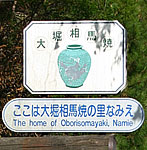
| Somayaki was established in 1690 in Fukushima, Northern Japan. During the Edo period,
it enjoyed the protection of the Soma lords and grew to over 100 kilns,
making it one of the biggest and most important potteries in Northern Japan.
However with the advent of the Meiji restoration, the influence of the
lords declined and the number of kilns gradually decreased to the 27 still
in production today. Somayaki is proud of its history and draws from 300
years of tradition to create distinctive, unique pieces popular with collectors
everywhere. One of the most recognisable characteristics of Somayaki is
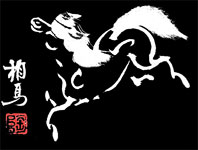
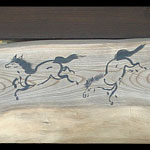
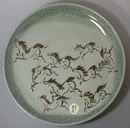
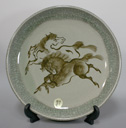
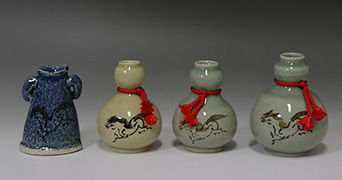
its "Hashirigoma"(galloping horse motif). The origin of the motif
is the subject of much speculation, but there can be no doubt that it is
related to Soma's long history of horse handling ( the "ma" in
Soma actually means "horse"). Over 1,000 years ago, horses were
used as a form of martial training. Warriors were prepared for battle by
trying to wrestle sacred banners from the backs of wild horses. This tradition
is re-enacted during the "Soma-nomaoi" festival held every July,
drawing many visitors to the area. The galloping horse motif is painted
on Somayaki following the tradition of the Kano School of Painting, one
of the most prominent and respected schools of art in Japan. Another unique
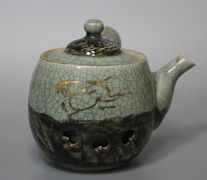
feature is the use of "double walls". The pieces are constructed
with an inner wall which can be seen through cut-outs in the outer shell.
As well as adding an interesting dimension, this feature also has the added
advantage of keeping the tea warm while leaving the outer surface cool.
"Aohibi" is the name given to the distinctive blue crackled glaze
seen on most Somayaki ware. A combination of these three distinctive features
combine to create warm, rustic pieces imbued with a sense of history and
peculiar to the area in which they are produced. |
||||||||||||||||||||||
|
||||||||||||||||||||||